Marsh Award Anniversaries 2026
12 January, 2026The MCT runs over 100 Awards with 48 partner organisations, with whom we strive to build long‑standing and meaningful relationships. Below, we are pleased to share some of the Award anniversaries we will be celebrating this year.
This year marks the celebration of our longest‑standing Awards partnership. Our relationship with the Zoological Society of London began 35 years ago. In 1991, the Trust introduced the Marsh Award for Conservation Biology, recognising individuals who contribute fundamental science to the conservation of animal species and habitats.
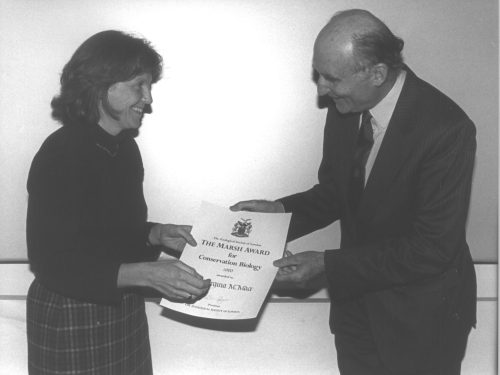
Pictured is Professor Dr Georgina Mace, winner of the Marsh Award for Conservation Biology in 1993. Since then, the scheme has grown to include four additional Awards that celebrate researchers and conservationists at various stages of their careers. From A-Level pupils studying biology, to university and early‑career scientists, to acclaimed conservationists, all are playing a vital role in protecting natural habitats and species for generations to come.
Thirty years ago, the MCT partnered with the British Ecological Society, the oldest ecological society in the world, dedicated to generating, communicating and promoting ecological knowledge and solutions worldwide. In 1996, the Marsh Ecology Award was introduced to recognise outstanding contributions to the science of ecology. This scheme has since expanded to include Awards recognising authors’ contributions to ecological literature, individuals making exceptional progress in climate change research, and the significant achievements of African ecologists.
This year also marks the 30th anniversary of our partnership with the Kent Wildlife Trust. Since 1996, these Awards have celebrated some of the 3,000 volunteers whose dedication and hard work make an invaluable contribution to the organisation. Each year, six volunteers are recognised for giving their skills, experience and enthusiasm to protecting Kent’s wildlife.
The Rare Breeds Survival Trust monitors rare breeds and the threats they face, ensuring that no breed of UK farm animal has become extinct since the organisation’s founding in 1973. The Marsh Award for Conservation in Genetic Biodiversity has been running since 1996 and recognises individuals or groups who have made significant technical, scientific, or practical contributions to the field of genetic biodiversity. Over time, the scheme has grown to include a Lifetime Achievement Award, running for 15 years, as well as an Award recognising the contributions of support group volunteers.
In 2026, we will celebrate the 20th anniversary of our partnership with the Refugee Council, one of the UK’s leading charities supporting refugees to rebuild their lives. The Marsh Refugee Volunteer Awards recognise volunteer‑led projects across England that provide essential services to refugees and asylum seekers.
Several Awards are also marking their 15th anniversaries this year. The Marsh Award for the Encouragement of Medallic Art, run in partnership with the British Art Medal Society, recognises individuals or organisations that have significantly advanced the understanding, appreciation, and promotion of the art of the medal. Our partnership with Engage also began in 2011, through which we present the Marsh Award for Excellence in Visual Arts Engagement. These Awards celebrate individuals working in learning and education roles within galleries or visual arts contexts across the UK.
The Marsh Award for Marine Conservation Leadership, launched in 2011 with Fauna & Flora International, recognises individuals and organisations making a profound impact on marine conservation and their local communities. This scheme has expanded to include Awards for terrestrial conservation leadership and for early‑career conservationists. Another partnership that began 15 years ago is with the Human Trafficking Foundation. The Marsh Award for Outstanding Contribution to the Fight Against Modern Slavery highlights the achievements of groups and individuals working to combat modern slavery in the UK and internationally.
National Historic Ships will also be celebrating its 20th anniversary this year, alongside 15 years of Award partnership with the Trust. These Awards honour individuals and volunteer teams, including those within the NHS ShipShape Network, who have made significant contributions to the conservation or operation of historic vessels in the UK.
In 2016, we introduced the Lucy Mair Medal and Marsh Prize to our partnership with the Royal Anthropological Institute. The Lucy Mair Medal honours excellence in applying anthropology to the relief of poverty and distress, and to the active promotion of human dignity.
Our Awards Scheme with the Churches Conservation Trust recognises volunteers across the UK who dedicate their time to conserving, protecting, and promoting the use of church spaces. Ten years ago, the scheme expanded to include the Marsh Award for Volunteer Team of the Year, which highlights the achievements of volunteer teams or friends’ groups who have delivered successful projects, events or activities together.
With the Institute of Historic Building Conservation (IHBC), the UK’s principal professional body for building conservation and historic environment specialists, we will celebrate our 10‑year Awards anniversary in 2026. The Marsh IHBC Award for Successful Learning in Heritage Skills recognises individuals who have demonstrated significant development in traditional building activities and craft skills. The Marsh IHBC Award for Community Contribution celebrates retired IHBC members who have made valuable contributions to civic and heritage projects and encouraged the preservation of local heritage.
The MCT is grateful for all of our Award partnerships, and this year we look forward to celebrating new developments within our schemes as well as welcoming new partners. Please visit our Partners page to explore all of our partner organisations and the Awards we run with each of them.
Pictured is Professor Dr Georgina Mace, winner of the Marsh Award for Conservation Biology in 1993.
Heather Crombie