Celebrating ZSL’s 200th Birthday
29 April, 2026We are excited to be celebrating ZSL’s 200th anniversary this year, as well as our own personal partnership with them of 35 years! ZSL has achieved so much over the last two centuries and we are so pleased that they have been able to work with us to recognise the individuals that have contributed to the education and conservation of animals worldwide and their habitats.
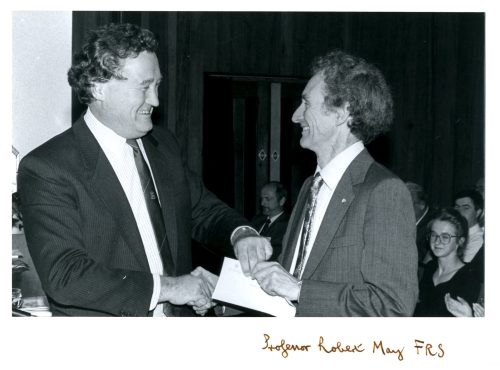
Our Awards partnership began in 1991 with the Marsh Award for Conservation Biology and recognises an individual for their contributions of fundamental science to the conservation of animal species and habitats. Our very first winner was Professor Robert M May for his contributions to many institutions and research into how populations are structured and respond to change, particularly with respect to infectious diseases and biodiversity., and the structure and dynamics of ecosystems, with particular emphasis on their response to disturbance, natural or human-created.
Our 10th anniversary of this Award highlights the work of Dr E J Milner-Gulland for her work relating to the interaction between the population dynamics of exploited species and the incentives experienced by the people who hunt them.
Our 20th anniversary of this Award recognised Jane Hill, for her elegant research combines fieldwork, analysis of historical records and climate modelling to show how habitat degradation and climate change affect insect distribution and abundance. In 2021, our 30th anniversary, we recognised Professor Rose Woodroffe, an exceptional zoologist with wide-ranging interests in carnivore behaviour, conservation, human-wildlife conflicts and disease.
In 2005, the MCT and ZSL introduced the Marsh Award for Marine and Freshwater Conservation recognises an individual for their contributions of fundamental science to the conservation of marine and freshwater ecosystems.
The inaugural winner of this Award was Professor Ian Boyd. Ian was Professor of Natural History at the University of St Andrews and Director of the Natural Environment Research Council Sea Mammal Unit, one of the foremost research institutions on marine mammals.
Our 10th year winner for this Award was Professor Paul Thompson, a distinguished marine conservation scientist, with a research focus on how environmental change and human disturbance affect seabird and marine mammal populations.
In 2025, we celebrated 20 years of this Award, and recognised Nicholas Graham, combining groundbreaking research with measurable global impact on conservation and human wellbeing. His research has consistently transformed our understanding of coral reef ecosystems.
Our Awards with ZSL also recognise young people from A-level projects to post graduate students. In 2007, the Thomas Henry Huxley Award and Marsh Prize was introduced to recognises a postgraduate research student whose thesis has made a significant contribution to a particular scientific field. Our inaugural winner for this Award was Tim Hawes. Tim explored the processes that enable certain arthropods to inhabit the exceedingly cold ecosystems of terrestrial Antarctica. In 2017, we celebrate 10 years of the Award. Our winner was Shana Caro, winning this Award for her thesis entitled ‘Social and environmental factors in the evolution of signalling’, focusing on signalling between parents and offspring.
In 2008, the Prince Phillip Award and Marsh Prize was introduced to recognises excellence and contribution to science, whilst encouraging students to see biology as a relevant and exciting field of study. Anthony Yong Kheng Cordero Ng was the first winner of this Award for his project that tested he extent of resistance to heavy metal pollution by mosquitoes in Malaysia. In 2018, our 10th anniversary of the Award, Mhairi McCann won for her project on the impact of novel agrochemicals on the activity of the marine intertidal amphipod Echinogammarus marinus.
The Charles Darwin Award and Marsh Prize was introduced in 2009 and recognises the best zoological project by an undergraduate student attending a university in Great Britain or Northern Ireland. Our first winner was Haihan Tan, recognised for the project ‘Novel roles of nuclear receptors in cell fate decisions of neural stem cells and differentiated progeny in Drosophila’, certain types of what are commonly called fruit flies. Katherine Assersohn won the Award in our 10th year for project ‘Inbreeding and prenatal maternal investment have no detectable influence on sperm numbers in Japanese quail (Coturnix japonica)’.
#HappyBirthdayZSL #ZSLAt200 #CreatingChange #TrainingConservationists